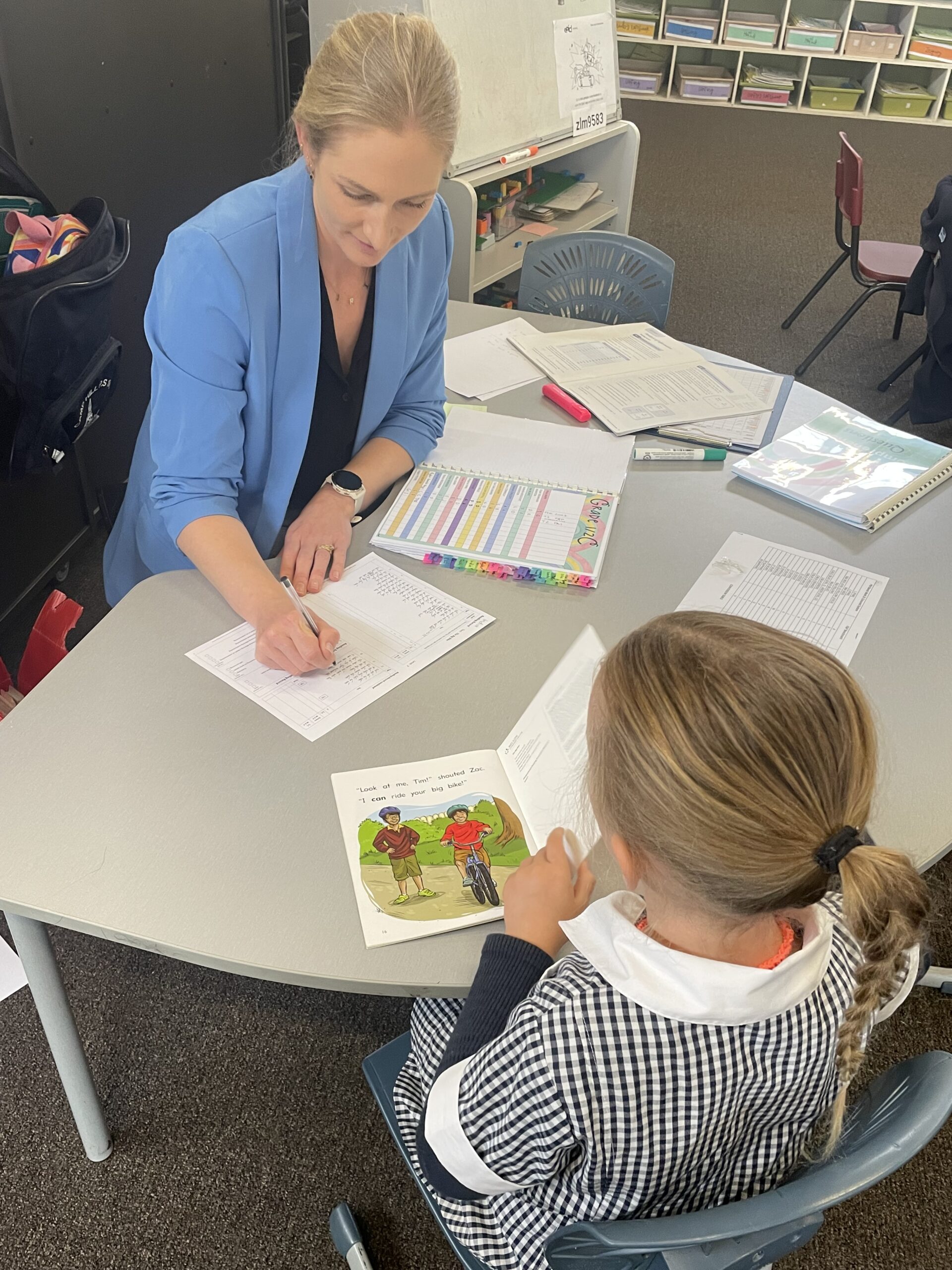
The English program at Camp Hill Primary School will provide opportunities for each child to:

  • Speak, listen, read, and write effectively with confidence, purpose, and enjoyment through immersion in planned reading, writing, speaking and listening activities
  • Grow in confidence when communicating with others
  • Develop an understanding of how to use language appropriate to the social situation
  • Develop understanding of the structure of different genre and use them in writing
  • Discuss and analyse texts and language critically
  • Develop a fluent Victorian Cursive Script writing style

Camp Hill PS uses the 6+ traits to guide our students to become effective and engaging writers

  • Organisation
  • Ideas
  • Word Choice
  • Presentation
  • Voice
  • Sentence Fluency
  • Conventions

Reading
Reading is a foundational life skill and a source of pleasure and wonder. It provides access to information, generates imagination, builds knowledge, enables creativity and shapes opinions.
Our approach to teaching reading is supported by the strongest evidence and follows the expectations to be implemented in all Victorian government primary schools in 2025.

Teaching reading
The essential elements of reading form part of our structured literacy approach and includes:

  • Oral language – knowing and using spoken words to express knowledge, ideas and
    emotions
  • Phonemic awareness –which is the knowledge of sounds (phonemes)
  • Phonics – knowing the sound (phoneme) and letter (grapheme) relationships
  • Fluency – reading accurately and at an appropriate rate with expression
  • Vocabulary – understanding words in isolation and in context
  • Comprehension – making meaning from text which includes developing knowledge of

These are the foundational skills that have a reciprocal relationship and are all necessary to enable students to independently read and respond to increasingly complex fiction and non-fiction texts.
In the early years of school, the development of decoding skills is best developed through a minimum of 20-25 minutes of daily explicit teaching of phonics and phonemic awareness using a systematic synthetic phonics approach.
This means our teachers use a clear scope and sequence of increasingly complex grapheme-phoneme correspondences and morphology.
Students first learn to pronounce single letters and sounds and then blend them to form words. It also involves teaching students to segment sounds and spell words to make the link between reading and writing.
Decodable texts are used to practice the letter-sound combinations that students have been taught.
This builds students’ skills so they develop automaticity and so can read words quickly and accurately.

Timetabling ensures a daily two hour Literacy program providing focused teaching of Reading, Writing, Speaking and Listening skills in all year levels.
In Foundation – Year 2 classes, the literacy block will be timetabled for the first two hours of each school day. In Years 3-6 classes, the literacy block will be timetabled 11.25 -1.25 pm of each school day.

Resources